IEEE Robotics and Automation Letters (RA-L), 2026

Embodied Scene Rearrangement Planning

School of Computer Science and Technology, Beijing Institute of Technology, Beijing, China
*Equal contribution  ·  Corresponding author

Overview

ESRP task overview

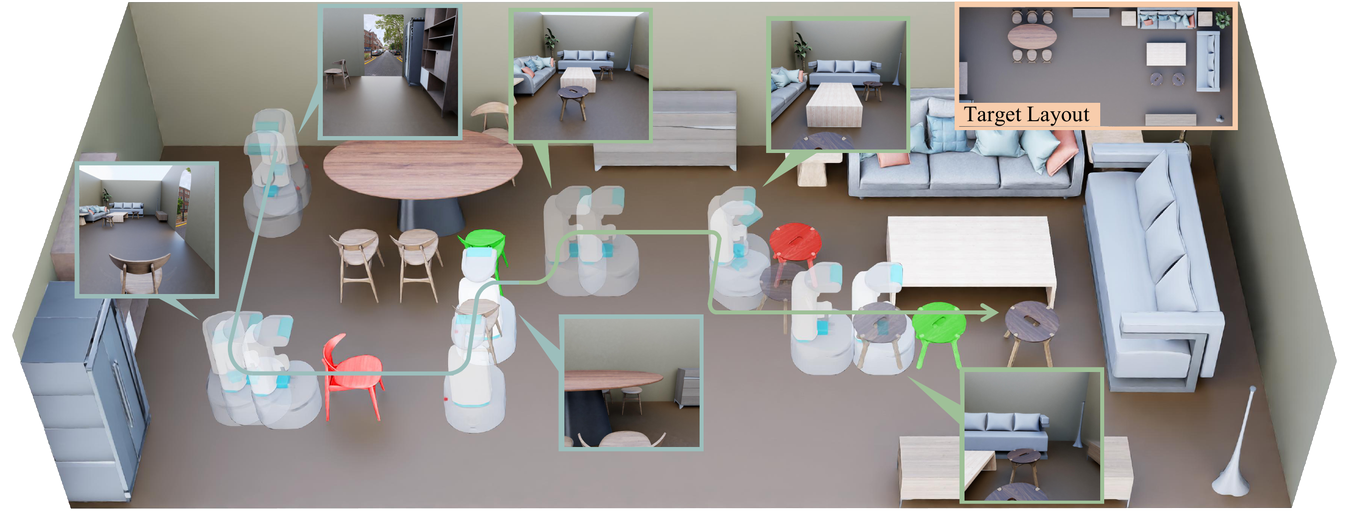
Overview of the ESRP task. Given a top-down target layout, an embodied agent needs to rearrange furniture in a 3D scene from an initial configuration (red) to a target state (green). The agent operates under realistic constraints, relying only on egocentric observations without access to global state information or ground-truth localization.
Abstract

This paper introduces Embodied Scene Rearrangement Planning (ESRP), a task in which an embodied agent rearranges furniture to match a target configuration using egocentric observations and a top-down layout image. The agent has no access to the global state, and furniture can occlude other objects. It must therefore connect partial local views to a global target over a long sequence of actions. We built ESRP-Bench on OmniGibson with more than 5,400 scene pairs and 8,100 objects. The benchmark includes three evaluation metrics and four baselines: a task-and-motion planner, a vision-language-model-based method, and imitation-learning and reinforcement-learning agents. All four methods have difficulty completing the task efficiently, particularly in scenes with several objects. The results point to scene understanding and long-horizon planning as the main open problems.

Partial Observability

The policy must align partial, first-person views with the target layout and infer spatial information solely from local perception.

Complex Inter-Object Dependencies

The agent must generate plausible action sequences while reasoning about inter-object dependencies to avoid physical deadlocks and mutual occlusions.

Dynamic Scene Evolution

Every moved object changes the scene, so the agent must update its perception, localization, and navigation plan as it works.

Benchmark

Initial-target scene layout pairs

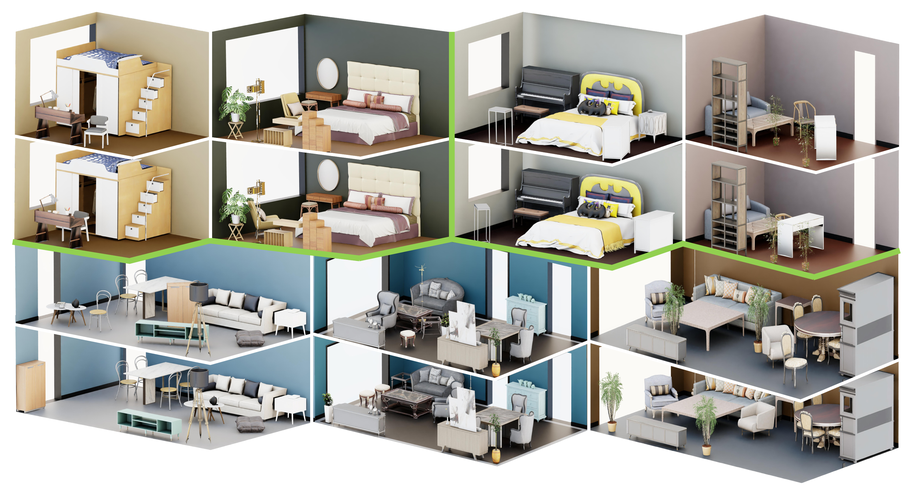
Initial-target scene layout pairs. We group layouts into three difficulty levels: easy (1 object to rearrange), medium (2 to 3 objects), and hard (4 to 6 objects). ESRP-Bench uses 3D-FRONT scenes simulated in OmniGibson. It contains more than 5,400 scenes and 8,100 movable objects from several room and furniture categories.

Method & Baselines

Pipeline overview

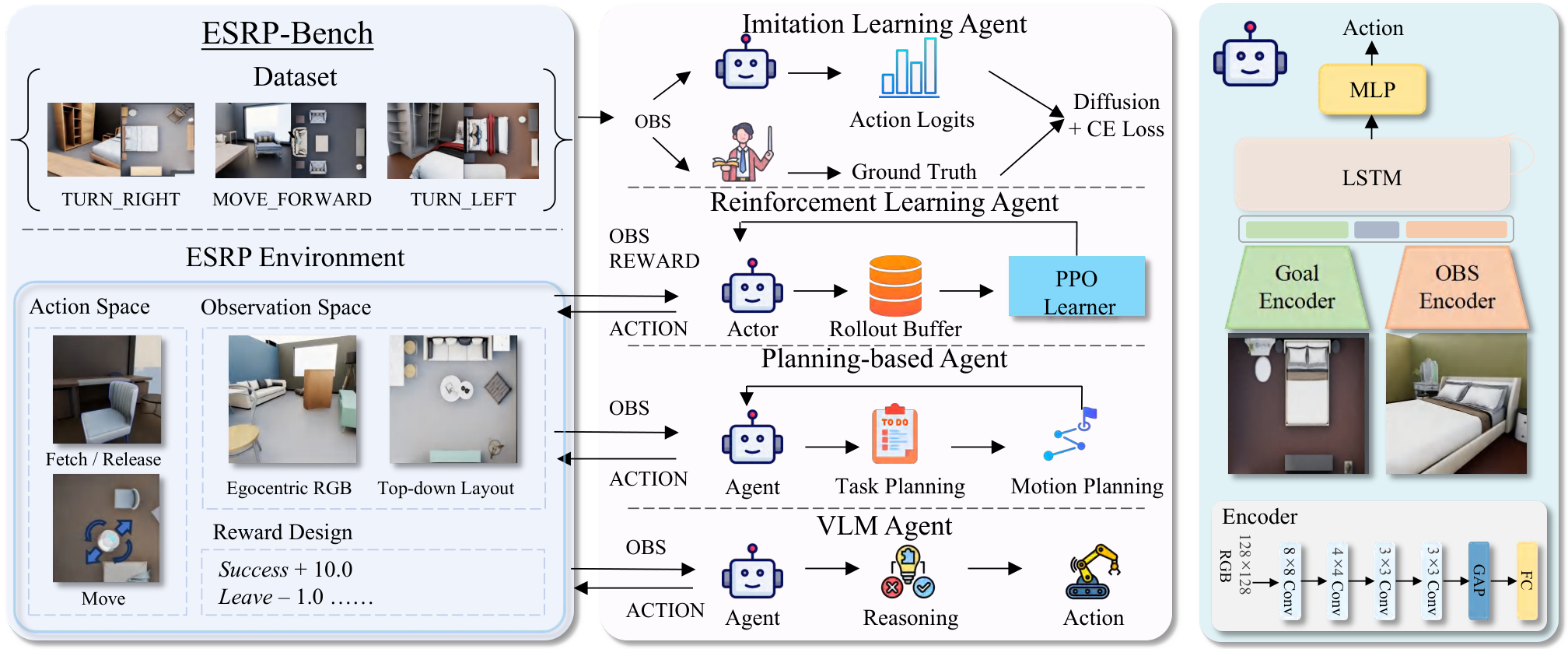
Pipeline overview. ESRP-Bench contains the dataset and simulation environment. We evaluate four baselines: ESRP-BC, a diffusion policy trained on expert demonstrations; ESRP-PPO, a reinforcement-learning agent; ESRP-VLM, which prompts a pretrained vision-language model in a ReAct loop; and ESRP-PLAN, a hierarchical task-and-motion planner with access to the global state.

Results

BaselineSR ↑OSR ↑RDR ↓
ESRP-PPO20.18%20.35%0.9845
ESRP-BC19.09%20.31%1.0170
ESRP-VLM17.64%18.97%0.9830
ESRP-PLAN30.20%36.59%0.6916

The strongest baseline has access to the global state but reaches only a 30.20% success rate. Long-horizon planning remains difficult when the learning-based agents receive only egocentric observations.

Qualitative Results

Successful rearrangement examples

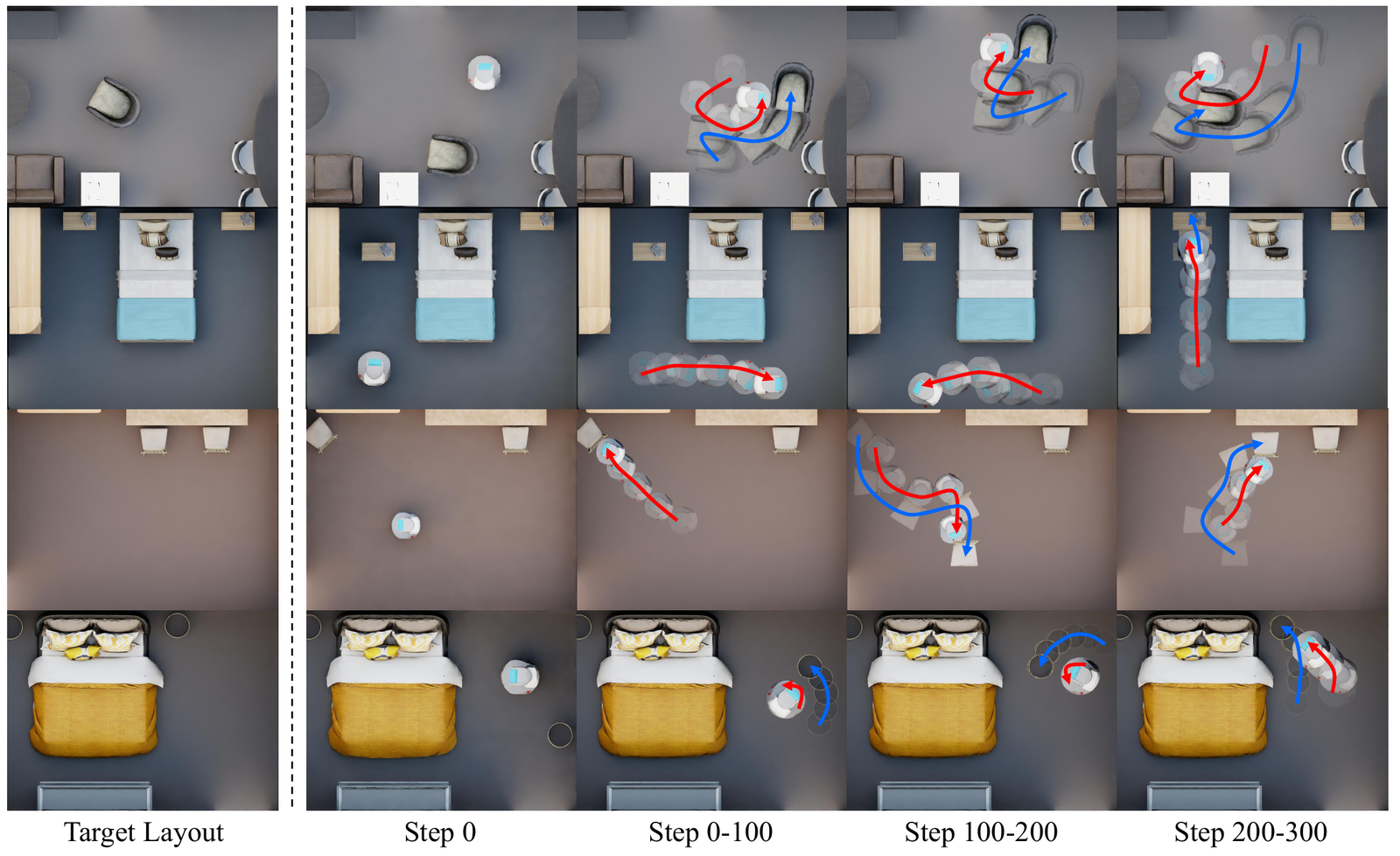
Successful rearrangements. The red curve shows the agent’s trajectory; the blue curve shows the moved object’s trajectory.

Failure cases

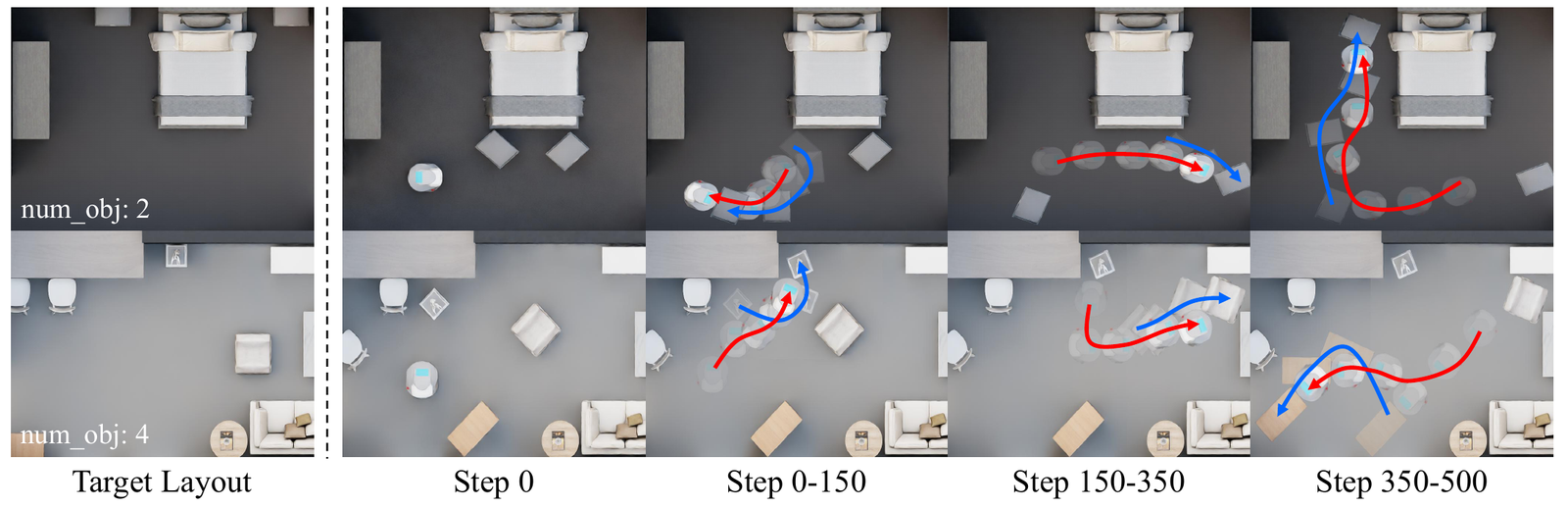
Failure cases. As the number of rearrangeable objects increases, long-horizon complexity makes the task substantially harder; the agent can only approximate the target layout.

BibTeX

@article{chen2026esrp,
  title     = {Embodied Scene Rearrangement Planning},
  author    = {Chen, Canzhi and Wang, Zan and Zhu, Siqi and Wu, Qi and Li, Yixuan and Liang, Wei},
  journal   = {IEEE Robotics and Automation Letters},
  year      = {2026},
  publisher = {IEEE}
}